The clinical file
Thymosin alpha-1 and immune recovery
Restored immune-cell measurements are compelling. Survival in a clinical trial is a further question, and the sepsis record gives it an awkward answer.
Exhausted T cells in severe COVID-19
The word restoration appears directly in the report on 76 patients with severe COVID-19. Thymosin alpha-1 treatment was associated with increased T-cell numbers in patients with severe lymphocytopenia, meaning a shortage of lymphocytes, and reduced PD-1 and Tim-3 expression on CD8+ T cells. Those measurements were interpreted as reversal of T-cell exhaustion. Mortality was 11.11% versus 30.00%, P=0.044.
I initially liked the pairing: a cellular explanation alongside a clinical association. But the study looked back at patients' records. Treatment allocation was not randomized, so differences between the groups could contribute to the apparent benefit. I give the cell findings room to be interesting while reserving judgement about a survival effect.
Sepsis mortality: ETASS, then TESTS
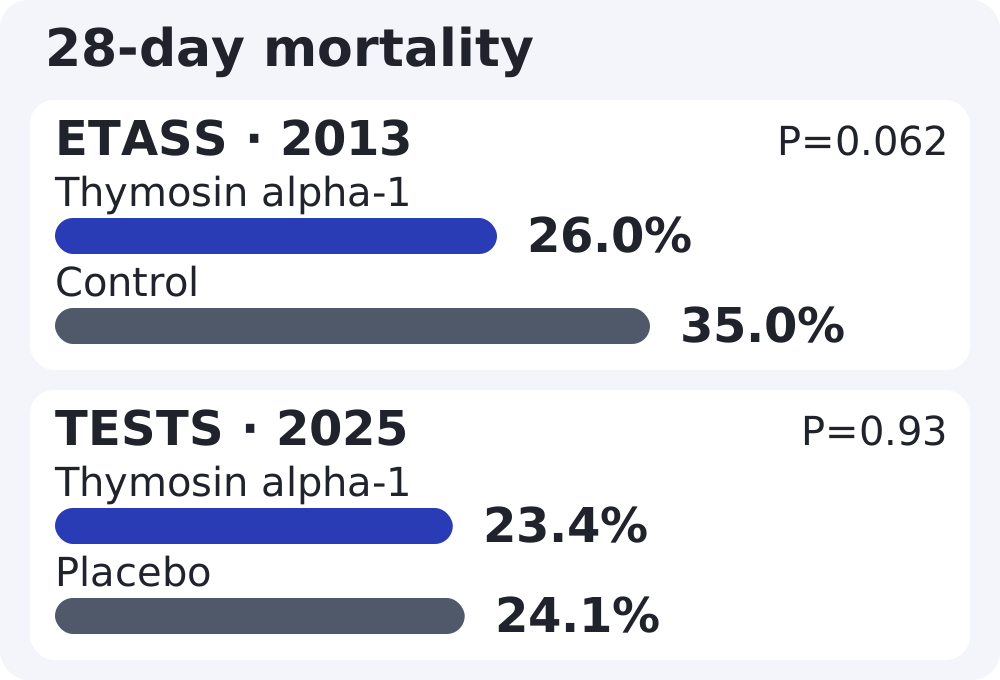
The earlier ETASS sepsis trial enrolled 361 patients with severe sepsis. Its 28-day mortality figures were 26.0% with thymosin alpha-1 and 35.0% in controls. The nonstratified P=0.062 and log-rank P=0.049 make the result less tidy than a simple positive headline; monocyte HLA-DR expression also improved.
Then TESTS enrolled 1,106 adults across 22 centres in a phase-3 double-blind, randomized, placebo-controlled trial. Mortality at 28 days was 23.4% with thymosin alpha-1 and 24.1% with placebo: hazard ratio 0.99 (95% CI 0.77–1.27), P=0.93. It found no statistically significant mortality benefit.
For me, TESTS sharply limits the sepsis claim. It leaves other diseases and more specific immune questions to their own studies. Improved HLA-DR expression and reduced exhaustion markers can be real research findings without settling whether a treatment helps people survive sepsis.
The peptide and its regulatory arm
Thymosin alpha-1 is a 28-amino-acid peptide; the synthetic drug thymalfasin has the same sequence. The original calf-thymus isolation established its structure in 1977. Its name can easily lead to confusion with thymosin beta-4, an actin-binding peptide from a different family. Thymulin is another distinct molecule.
The mechanistic work gives thymosin alpha-1 a more complicated role than simply turning immunity up. In mouse and human dendritic-cell experiments, including mouse work in vivo, it activated the IDO pathway, which breaks down tryptophan, and promoted interleukin-10 and regulatory T cells alongside Th1 priming. I prefer this account of simultaneous activation and regulation to the vague appeal of an immune boost. The mechanism also explains the theoretical concern in autoimmunity or transplantation, where stronger effector activity could be unwelcome.
What the research shows
Isolation and structure. Thymosin alpha-1 was purified from calf thymus fraction 5 in 1977; Goldstein and colleagues determined its complete 28-residue sequence and established its immunological activity [7].
Sepsis — the null large trial. The phase-3 TESTS trial enrolled 1,106 adults with sepsis across 22 centres in a double-blind, randomised, placebo-controlled design. Twenty-eight-day all-cause mortality was 23.4% in the thymosin alpha-1 group versus 24.1% in placebo: hazard ratio 0.99 (95% CI 0.77–1.27), P=0.93 [1].
Sepsis — an earlier positive signal. The multicentre ETASS trial of 361 severe-sepsis patients found 28-day mortality of 26.0% (Tα1) versus 35.0% (control), an absolute reduction of ~9 percentage points that did not reach conventional significance (P=0.062; log-rank P=0.049) and was accompanied by improved HLA-DR expression on monocytes [5].
COVID-19. In a retrospective review of 76 patients with severe COVID-19, thymosin alpha-1 was associated with significantly reduced mortality (11.1% vs 30.0%, P=0.044), increased T-cell numbers in lymphocytopenic patients, and reversal of CD8+ T-cell exhaustion markers [3].
Cancer adjuvancy. A review of oncology data positions Thymosin Alpha-1 as an immunostimulatory adjuvant used in combination with chemotherapy and immunotherapy in melanoma, hepatocellular carcinoma, and lung cancer, potentially converting immunologically "cold" tumours and mitigating checkpoint-inhibitor toxicity through mucosal homeostasis [4].
Mechanism. The 2006 mechanistic study confirmed TLR9-dependent IDO activation on dendritic cells, establishing the dual Th1-priming and regulatory framework [6].
Safety profile. A comprehensive review of four decades of clinical literature establishes a benign safety profile. The most common adverse effects are mild local injection-site irritation; the standard single subcutaneous dose ranges from 0.8 to 6.4 mg; thymalfasin is approved in more than 35 countries [2].
Research-labelled thymosin alpha-1 is still sold for laboratory use; prescription care is a separate route. For thymosin alpha-1 care, Promise Peptides (mypromise.com) currently prescribes the medication; a clinician licensed in the U.S. examines every request before issuing a decision, and some requests are refused. This care is for U.S. patients only, and availability varies by state and treatment. Compounded medications are not FDA-approved. The trials above are what that provider has to reason from.
Safety and reported experiences
The comprehensive clinical review describes generally good tolerability, with mild local injection-site reactions the commonest adverse effects. Dedicated pregnancy and lactation safety studies are absent. Research-grade material adds separate uncertainty about identity, content, purity and sterility. Thymosin alpha-1 is not FDA-approved for marketing in the United States.
Community accounts include fewer colds, quicker recovery, steadier energy, redness or stinging, occasional aches, headache or tiredness, and no noticeable change at all. These are anecdotal reports rather than clinical evidence; there is no controlled comparison behind the impressions. I give little weight to a feeling of immune resilience when the clinical papers themselves are measuring such different things.
A thymosin alpha-1 research peptide and a thymosin alpha-1 antibody also describe different laboratory materials. The papers here concern the peptide's biology and clinical investigation; they do not authenticate an antibody reagent or a laboratory product. The thymus peptide FAQ separates the recurring names, and the reading list contains the original sources.